Wednesday, April 27, 2022

DR. R. SIMPSON : PRINCIPAL 1933-1937. FAR AHEAD OF HIS TIMES?


 DR. R. SIMPSON : PRINCIPAL 1933-1937. FAR AHEAD OF HIS TIMES? 

Filling in the shoes of the Rev WHG Padfield was a huge challenge. An entire generation knew no other Principal of the Lawrence Memorial Royal Military School, Lovedale. The Rev Padfield had epitomized the school from 1908 to 1932 - nearly a quarter of a century. 

The man who succeeded him turned out to be an achiever too. One who brought in a lot of progressive reform, particularly in the eyes of the students. He was the Rev R W Simpson, M Sc,  D Phil (Oxon), FRES who took charge as the Principal in 1933.

In the picture below, Rev Simpson is seen with Sir Norman Marjoribanks KCIE, CSI, former Governor of Madras during his visit to Lovedale in 1934.


After his first year in office, Dr Simpson wrote, “ I felt at the beginning of the year soon after my arrival...that the Public School System of England....might be adopted to the needs of Lovedale School and after a full year of trial I feel more optimistic. The running of the School out of class hours is now practically entirely in the hands of the Prefects who have shouldered their responsibilities admirably.”


An Old Lawrencian remembered, " My last years at school took place under the ‘reign’ of Dr. Simpson who, in four short years, changed the whole concept of Lovedale’s development towards the ideals of a public school. Before his time it was run like an orphanage (and I should know!) Dr. Simpson (affectionately known as ‘Boss’) was responsible for (would you believe?) introducing crockery to replace ‘tin’ mugs and plates, the paneling of the dining hall (it used to look like a Victorian railway station), the building of flush toilets (they didn’t exist before), the introduction of baths (only showers before then), the building of chemistry, physics and biology labs and a host of other physical alterations, too numerous to mention here.”

He gave more emphasis to cultural activities and the students presented more plays including one in French- for the first time in Lovedale. 


The Large Hall was renovated during this period as was the Church. 

Another Old Lawrencian of those times recalled : " Well, he revolutionized the school. The food was dramatically improved, and so were the uniforms. Instead of eating off Aluminum plates and mugs we now had crockery imported from London, plates and mugs were of white china with blue rims and the school crescent on all the china. The girls had terrible uniforms of khaki! Black wool stockings and black boots . We now were dressed like English school girls, in brown tunics, cream blouses, and brown shoes and stockings - no more boots and no more khaki! "

The pictures below accentuate the point made by this OL. 


Here's an account of Dr Simpson from an Old Lawrencian: "He was an outspoken man. For church services, instead of wearing the usual vestments he wore his red Oxford Doctor of Divinity Gown and looked very dramatic and imposing. Both Girls and Boys admired him enormously. We cried buckets when he was terminated. I remembered what the school was like before Dr. Simpson came and I was terrified that conditions would revert to the former Dickensian style. Remember the school was founded for orphan children of British soldiers (not officers) and the boys were encouraged to join the British army into the Boys Service - not as officers - and sent to Chepstow in Wales, England at the age of 14. Dr. Simpson wanted the boys to stay longer in school, get the Senior Cambridge, and be trained for the Indian Army as Officers."

It is said that Dr Simpson wanted to widen the scope of the school to include Indians amongst both staff and pupils. This apparently did not endear him to the Board of Governors of those days. There was also a controversy in his spending on items which they considered were not essential. Perhaps he wanted to bring about many changes too soon! 

Dr Simpson resigned in 1937 after four years as the Principal of the school. Some believed his services had been terminated. It was obvious the students missed him terribly, less so the Board of Governors! 

Writing of Dr Simpson 85 years after he left the School, we are left pondering :  Was he far ahead of his times? 

Pictures here are courtesy the Holdaway Family website and used with gratitude and with no commercial or profit motive whatsoever. "My Life Story" is a fascinating account of those times by Derek Holdaway, who is sadly no more. He studied in Lovedale from 1943 to 1948. His parents Walter Holdaway and Barbara Holdaway (nee Walton) were Old Lawrencians too and his mother was at school during the Simpson era. 

Readers may also like to see Glimpses of A Glorious Past of August 2021 in the OL Assembly show. 


Tuesday, April 12, 2022

THE PADFIELD YEARS - PART II

 THE PADFIELD YEARS - PART II


In the last blog post we saw how the Rev William Herbert Greenland Padfield, MA (Cantab) became the Principal of The Lawrence Asylum in Lovedale in 1908. He served in this capacity till 1932, his record of 24 years at the helm of affairs remains unbroken to this day.

In this post, we record more of his achievements.  While much of the credit for the success of an institution has to go to the leader, in this case the Rev Padfield, we are sure he would have acknowledged the sterling role played by the Head Master, Mr. W R Ramshaw. He held that important post, from 1908 to 1930, almost totally overlapping Rev Padfield’s tenure.

Reflective of the many improvements that had taken place over the last 55 years, the Lawrence Asylum was renamed “The Lawrence Memorial School” on January 15, 1913. 

That year, borrowing from the English Public School system, three Houses were formed in the Upper School. The Houses were called Lawrence, ( after Sir Henry), Hope Grant, ( after General Sir James Hope Grant, who played a leading role in choosing Lovedale as the location for the expanded Asylum at Ootacamund, when he was the Commander in Chief of the Madras Army) and Murray Hammick, ( after Sir Murray Love Hammick KCSI, CIE a Madras Civil servant and a great friend of the School, who was the Acting Governor of the Madras Presidency in 1912). 

 Lovedale was far removed from the pitched battles fought in mainland Europe during World War I .The School Honour Board recorded some of the Old Lawrencians who distinguished themselves. Lt H R Vaughan IARO ( Indian Army Reserve Officer) attached to the 41st Dogras, part of the Indian Corps commanded by General Sir James Willcocks was wounded in the battle of Festubert in May 1915. #

We also now know that Capt. William Noel Atkinson, 2nd/10th  

Gurkha Rifles, Indian Army was killed by a sniper when leading his men to repel a fierce counter attack by the Turks at Gallipoli on June 29, 1915. He was the eldest son of  The School’s former Principal, the Rev. A.W. Atkinson. He was a graduate of the Royal Military College, Sandhurst, gazetted as 2 nd Lieutenant in 1903 when his father held office at Lovedale.


An article by Annamalai Palaniappan in The Lawrencian in June/July 1983, contains this interesting information, “ The School played its part during the Great War of 1914 – 1918 , when the boys and staff garrisoned Wellington. It is interesting to note that for the service rendered, over 40 General Service Medals were awarded. The Principal heard from 220 boys serving on different fronts, among whom 18 subsequently sacrificed their lives on various battlefields, and 17 gained honours and distinctions. At that time over 2,500 students of the school were scattered in the four corners of the Empire.”

Some of you may have seen a panel in the School Church that honours the memory of those who laid down their lives for King and Country during the First World War. Contributions for this came from the Old Lawrencians Club which Rev Padfield was instrumental in setting up. This was the forerunner of our current Old Lawrencians Association. 


In those days of Empire one of the most coveted trophies was the Lord Milner Trophy awarded at the close of the annual Imperial Challenge Rifle Shooting competition, open to boys and girls across the British Empire. It was a matter, therefore of immense pride for the Rev Padfield when the School won this prestigious trophy in 1919.


In January, 1921, the School was presented The King's Colors in an impressive ceremony at Madras by HRH The Duke of Connaught and Strathearn, uncle of the reigning Monarch, King George V. 


The cadets, 40 rank and file, 2 N.C.Os. (and 5 N.C.Os. for the colour party) under Sergt. Major Light, and the Band, (37 in number,) under Band Instructor Muddle, with Sergt. Munford, travelled to Madras. They stayed at the Royal Artillery Barracks in Fort St. George, where everything had been very kindly arranged for them by Q.M.S. Jeffery. 

An article in The Lawrencian notes, " We should like to thank Q.M.S. Jeffery most warmly for all his help, and for the very excellent catering arrangements which he made for us, giving the cadets absolutely the time of their lives. Drill starts at once, under the supervision of Captain Mc Enroy, M.C., who most kindly devoted himself to this task morning and evening, and to whom our thanks are largely due for the precision and accuracy which the cadets showed on “ the day.”  

 Punctually, on Saturday at 8 a.m., H.R.H arrived at the entrance to the pandal and was met by Their Excellencies, The Governor and Lady Willingdon. His Excellency then presented Sir. William Marshall, Mr.Knapp and Mr.Berridge as representing the School Committee and the Principal to His Royal Highness. H.R.H then  proceeded to the dais, where he was met by the Bishop of Madras. The School Band played“ God Save the King” and the cadets presented arms.

      The Bishop then consecrated the colours- which rested on an altar of drums kindly lent by the Leicester Regiment (The Royal Canadians). 


 H.R.H. then spoke as follows:“ It is a great pleasure to me to present these colours to the Lawrence Memorial School for I well know how close and honorable is the connection that binds you to the British Army.

          I congratulate your Principal and your Officers on the distinguished record your school has achieved and on the very smart appearance of the cadets whom I see before me now. I trust you will look upon these colours as the emblem of your duty to your school and country and I hope that many of those who are henceforth to serve under these colours will live to serve, The King Emperor with honour and distinction in the larger spheres of life.”

        The colours unfurled and turned towards the centre of the line were given a general salute – the colour party marched in slow time to its place in line, the band playing “God Save the King”. The platoon headed by the band, then marched passed in line.


        After the presentation, H.R.H. expressed to the Principal the pleasure which it had given him to present the colours to a school with such a splendid history and complimented him on their smartness and efficiency. His Excellency then sent for Mrs. Padfield and presented her to H.R.H.  The large and distinguished gathering present were loud in their commendations. A letter received by the Principal in his Excellency’s own handwriting will no doubt help to inspire succeeding generations to keep up to the standard set by the present boys. 

Encouraged by the favorable reports he received about the School, HRH kindly consented to become the Royal Patron of the School in 1923. 

In 1925, came what perhaps was the crowning point in Rev Padfield's tenure. The School was accorded the status of a Royal Military School by His Majesty King George V- it was only the fourth School in the British Empire to be bestowed with this honour.  

The first school to be so honored was the Duke of York’s Royal Military School at Dover, founded by Royal Warrant in 1803 as The Royal Military Asylum . It became the Duke of York’s Royal Military School in 1892. Next, the privilege was accorded to the Royal Hibernian Military School in Dublin , established in 1769 and accorded this honour in 1806. It merged with its sister school The Duke Of York's Royal Military School in 1924.


The third in the British Empire to be bestowed this honour was our very own Sister School at Sanawar, established in 1847 which was given the title of The Lawrence Memorial

Royal Military School in 1920.


This good news was reflected in The Rev Padfield’s report to the Chairman and Members of the Board of Governors of the School when he wrote with justifiable pride that His Imperial Majesty the King Emperor George V had “been graciously pleased to approve of the Lawrence Memorial School, Lovedale, being designated  ‘The Lawrence Memorial Royal Military School (Lovedale).”

After serving as the Principal for 24 years, the Rev Padfield retired and went back to England in 1932 leaving behind a lasting legacy.


As mentioned in the last blog post, under Rev Padfield the School had grown considerable in stature. An Asylum for  the children of British soldiers serving in India, especially the orphans, had grown to become a Royal Military School. 


We would encourage you to see the two episodes about Rev Padefield aired in the segment on "Glimpses of a Glorious Part " in the OLA's OL Assembly of  June 2021 and July 2021. 

# From : “The Indian Corps in France during the First World”, by John Walter Beresford Merewether CIE).

## Extract from the “Statesman” January 18, 1921


Thursday, March 31, 2022

THE PADFIELD YEARS

 THE PADFIELD YEARS

When Rev Atkinson, the Principal since 1891 passed away in 1907,  Mr. John Herbert Robertson, ICS , Collector, Magistrate and Additional Sessions Judge at Ootacamund and the Vice Chairman of the School Committee was assigned the task of finding a suitable replacement for him. 

Interim arrangements made for the management of the Institution saw Major-General G. Simpson, C.B. act in the appointment until July 1907. He was then relieved by the Rev. Canon J.W.Foley M.A.who agreed to undertake the office until engagement of a permanent Principal. 

Advertisements were placed by the Committee both in England and in India and much effort was made to identify the right person. They found him, not in England but in the foothills of the Himalayas at Murree, in the Punjab. He was eminently suitable for the position having since 1904 been the Principal and Secretary of a sister school, the Lawrence Asylum/Memorial School  at Ghora Ghalli , near Murree (founded in 1860). 

His name: The Rev. William Herbert Greenland Padfield. MA.

This was the man to whom much of The Lawrence School's future successes would be attributed. Former School Archivist Nitya C. Matthai has called Rev Padfield “The Renaissance Man" who brought in many improvements over the years. 

Rev Padfield changed the tone and tenor of the school and gave it a military bearing. No one can see the future and in making the choice, the Committee perhaps would not have imagined that the new person at the helm of the asylum’s affairs would lead the institution for the next 24 years. He more than repaid the Committee’s judgement in his selection in that he achieved what most would have thought impossible, shepherding the progress of an asylum which provided shelter, food and a rudimentary education to orphans of British soldiers in India, to attain the status of a “Royal Military School". One of just four in the British Empire. 


The dawn of the 20th century saw the British still enjoying the privileges of living in what was famously called the Imperial Century. This lasted from 1815 to 1914. The British Empire was the most powerful in the world. Queen Victoria was on the throne as she had been since 1837. 

Most in the Empire had lived under no other monarch and more pertinent to our story, India was now considered the jewel in the British crown. Reflecting this, Queen Victoria assumed the title of Empress of India at the first Grand Durbar, popularly called the “Proclamation Durbar” on January 1, 1877. It was presided over on her behalf by the Viceroy and Governor General in India, Lord Lytton, who visited Lovedale later that year. 


But as they say, The Reaper comes for all, prince or pauper, and when the much lamented Queen passed away in 1901 she was succeeded by Edward VII who had been created Prince of Wales sixty years ago. He had been Heir Apparent for as long as most people could remember. His coronation was again celebrated with a Durbar in Delhi in 1903. 


Edward VII did not attend this in person but deputed his brother HRH Prince Arthur, The Duke of Connaught to represent him.  As our story unfolds, we shall see how His Royal Highness Prince Arthur became associated with the School, consenting in later years to become the Patron of the School.

The early years of the new century saw a considerable improvement in the ratio of girls to boys at The Lawrence Asylum, now in Lovedale. You will recall this Asylum had been established on September 6, 1858 in memory of Major General Sir Henry Lawrence, KCB. 


In 1904, a hundred girls were transferred from the Female Military Asylum in Madras just as earlier in 1871 the boys had been from the Male Military Asylum. The Girls then resided in what we now know as the Prep School. The “Red Fort “( as the current Girls School is called) was as yet unbuilt.


The Rev Padfield, was just 33 years old in 1908 when he moved to Lovedale. He held a MA from Cambridge. His nomination was duly confirmed by the Government of Madras in order No. 692 Educational, Dated 11th  October 1907  and he assumed office on February 4, 1908. 

The year of Padfield’s joining saw the School being raised to a High School.  This is to be seen in the context of only 8 % of India’s population being literate even more than a decade later in 1921.The institution was divided for teaching purposes into three departments, namely the Boys School,  The Girls School and the Kindergarten. 

The first landmark of the Golden Jubilee of the Asylum was celebrated in 1908. Fifty years had flown past since the Lark Hill and Stonehouse days. Addressing the audience at the Golden Jubilee, an important milestone in the history of the school, the Rev Padfield said the Lawrence Asylum had 465 children on its rolls. He went on, “ In respect of climate, space for play-grounds, buildings, surroundings, and contiguity to the Railway, the Ootacamund Asylum can, without fear of challenge, claim to hold the first place amount all schools on the Indian Hills. 

During the half century that has elapsed since the foundation of this Asylum, the 2,149 boys and 458 girls who have passed through it, have, for by far the greater part, been housed, fed, clothed, and educated gratis and have, to a distinctly appreciable extent, been taught, by their residence in it, habits of obedience, discipline, and method. 


I venture to think that their appearance will amply testify that they have here a home such as I feel sure that Sir Henry Lawrence would have desired for them. Their proper upbringing is the constant and anxious care of those to whose charge they have been committed, and it is the steadfast aim of the staff of the Asylum to, in the present, as in the past, do their duty by them in all things, and in doing this to teach them one and all, to do theirs; not only now, but also after they have passed from within these walls into the battle of life.”


There are many iconic landmarks in Lovedale that date back to the Padfield era. The Flagstaff and the 67 Steps that lead up to the senior school from the Junior School number among them. They were built in 1910 the year Britain got a new King when in May 1910  King George V succeeded his father, King Edward VII. In the next year the new chapel - The Church of the Ascension- was built for the Church of England replacing the old one in the main school building ( our current Large Hall). 


The Rev Padfield stole a march over the redoubtable Rev Alfred H. Hildesley, Principal from 1884-1912 of the Lawrence Asylum, Sanawar the senior most of the Lawrence Schools by starting a magazine which he called most appropriately, “The Lawrencian” in 1911. “The Sanawarian” we know was first published in 1913. 


In April 1911, the newsletter was established, ‘for the purpose of chronicling the progress of the ….and thus keeping the ex-pupils in close contact with their Alma Mater. It would thereby, we trust, be the means of creating a strong bond of sympathy and fellowship among all those interested in the welfare of a very useful and honoured institution’ as stated in the Editorial of the inaugural issue. This was published quarterly with an annual subscription of Rs.1/- with Mr. F W Haughton as the Editor. 


The Rev Padfield with school staff in 1913. 

The period of tranquility would shortly be shattered with the First World War breaking out in 1914. 

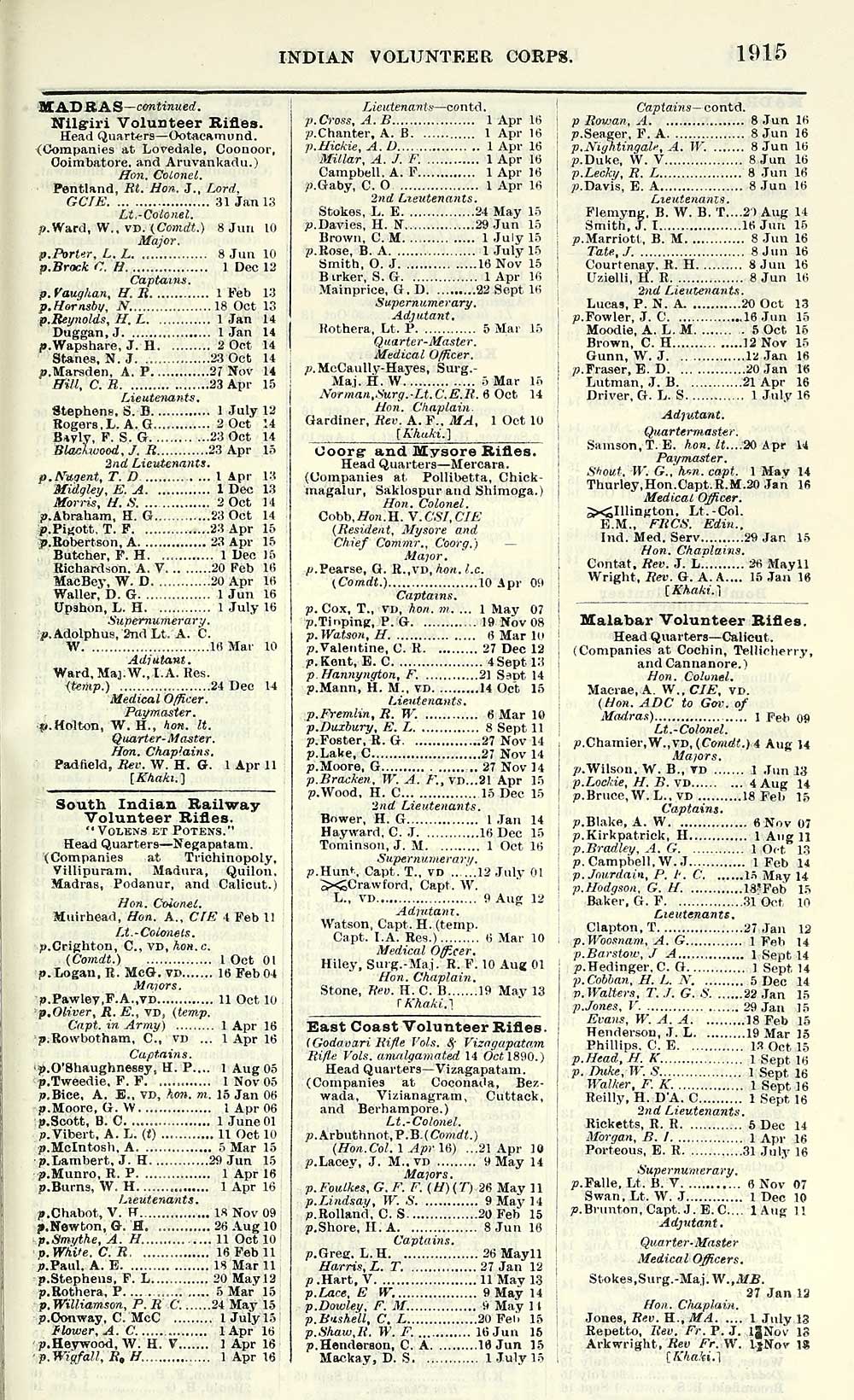
During the First World War, Rev Padfield was the Hon Chaplain of the Nilgiri Rifle Volunteers, headquartered in Ootacamund with companies at Lovedale, Aravankadu, Coonoor, and Coimbatore. The Hon Colonel was Lord Pentland, then the Governor of Madras.  

We shall have more about Rev Padfield and his management of the School in the next blog post. 

Thursday, March 3, 2022

THE FIRST PRINCIPALS AND OTHER CONTRIBUTORS

THE FIRST PRINCIPALS AND OTHER CONTRIBUTORS 

An institution with a history of over 160 years owes a lot to thousands of people who have contributed towards its growth over the years. Some names are remembered to this day but many are forgotten.

Today's blog post is about some of those who managed the affairs - and contributed towards the progress- of The Lawrence Asylum, Ootacamund/Lovedale for the first 50 years from its inception on September 6, 1858.


The Lawrence Asylum, Ootacamund in 1873: Picture courtesy: Wikipedia

In our story, the proverbial  "Early Bird" has to be the first Secretary of the Asylum Managing Committee, Mr E W Bird, who managed the affairs of the infant institution from 1858 even before a full time Principal was appointed. 

The Rev T Whitehouse, MA Cantab,  was appointed Principal in 1862 and held office till 1868. Much of the construction of the new buildings at Lovedale and the shifting of the asylum from Ootacamund took place under his watch. His assistant, the Headmaster, was Mr G W Armstrong who came from the Missionary Training School at Kottayam. 

In 1868, the Rev Whitehouse retired and sailed back to England being succeeded by the Rev Bliss. Mr Armstrong continued to serve as Headmaster till 1889. Of him,  it is said, " he exercised a remarkable and very beneficial influence over the boys committed to his charge, and his memory is still held in much esteem and reverence by many of his old pupils. After his death, a sum sufficient to found a medal bearing his name was subscribed and this was annually awarded to the best conducted boy of the year." 

George Webster, the student at the Asylum whom we have met in previous blog posts, wrote, " The even tenor of our lives was, within a few months of our taking possession of the new buildings (in Lovedale) rudely broken in upon by the untimely and greatly lamented death of Mrs. Annie Burrows in 1869, and in her, we nursery boys, lost our best and kindest friend. How shall I ever forget her many little nameless acts of kindness and of love?" 

Despite all efforts to trace the history of an institution over the last one and half centuries, I am afraid, there still could be gaps. We are not sure, for example, who was in charge from 1871 to 1874 when the Rev O Dene BA (Cantab), I Eccles, arrived.

The Rev Dene settled in for a long period of 17 years to bring a sense of greater stability to the Lawrence Asylum. In 1879, he was deputed elsewhere for Church duties but the Committee must have missed his presence. They somehow got him back -for we find that he was “re-elected” as Principal in 1880.

 Chief Instructor Ambrose Perkins was a key member of the Rev Dene’s personnel. He must have supervised the planting of six oak trees, equally divided between the Male and Female Branches of the Asylum, in 1883 and the erection of lightning rods on the school towers the next year. One gets the impression that Ambrose Perkins was, in a sense, the forerunner of a much later day Nicholls. It is quite amazing to know that the first eucalyptus oil distilled in the Nilgiris in 1885 was by none other than Mr. Perkins! To cap it off, we are told the oil was distilled using equipment manufactured in the School premises. Presumably the boys had a hand in this exercise supervised by the capable Mr. Perkins. 

Rev Dene's successor was the Rev Augustus W. Atkinson, MA (Dub), the last Principal in the 19th century. He was a former Headmaster of the Bishop Corrie's Grammar School at Madras, and came to Lovedale from Calcutta where he had an impeccable reputation as the Principal of La Maritiniere (founded in 1836). 

The Rev Atkinson remained in office till he passed away in harness, so to speak, in 1907. This paved the way for the Padfield era starting from 1908. 


To what extent did the Lawrence Asylum at Ootacamund/Lovedale meet Sir Henry Lawrence's vision in the first 50 years (1858-1908)? A report from the Asylum says, "It is heartening to know that as many as 2149 boys and 458 girls had got the benefit of an education here."

 Most of the boys had become soldiers or telegraphists. Had the boys and girls been provided with the skills and the spirit to carve out a better, more secure future for themselves? Had they imbibed the Christian values that Sir Henry sought to propagate? 

By all accounts, the first Principals of The Lawrence Asylum and their dedicated staff provided a solid foundation for the institution.

 We like to think Sir Henry, grave faced as usual, would have nodded his approval.


Monday, February 14, 2022

THE CHINESE CONVICTS AT LOVEDALE

 THE CHINESE CONVICTS AT LOVEDALE    

For most Lawrencians,  the only connection between Lovedale and the Chinese has to be with Shinkows the Chinese restaurant which has become a permanent feature in Ooty catering to generations of OLs.

However, today's blog post has nothing to do with Shinkows but is about the Chinese Convicts who were involved in building our school in the 1860s.  

In previous posts we have seen how Lovedale was selected as the best location for the expanded Lawrence Asylum in Ootacamund. A student of those times, George Webster has written about the move to Lovedale from Ooty in 1869. You will remember he wrote that over 500 Chinese convicts were busy at work building the new premises for The Lawrence Asylum at Lovedale. 

As we saw in a the last post, the buildings- which still stand majestically today- were designed by Robert Chisolm.  The construction was carried out by the Chinese convicts with technical and administrative direction from the British officers including those of the Madras Sappers. Now called the Madras Engineer Group, the Madras Sappers date back to 1780 when they were first formed as the Madras Pioneers. 

Many of you may know that Lovedale still has the Sappers Line which were probably occupied by these troops many, many years ago. 

In case you are wondering how these Chinese convicts reached Lovedale, here's what happened. 

The Strait Settlements came under the British East India Company following the Anglo-Dutch Treaty of 1824. Over time they came to be used as penal settlements for civilian and military prisoners from India and other  territories in this part of the world governed by the British East India Company. After 1858, the governing of India was taken up directly by the British Government.

In the second half of the 19th century, the prisons in the Strait Settlements were over crowded, so batches of convicts -including Prisoners of War from the Opium Wars- were shipped to the Madras Presidency. Here they were packed off to Naduvattam in the Nilgiris where they worked on construction projects taken up by the British and in the newly established tea plantations. 

This is what brought them to Lovedale where they worked from 1862 to 1869 building our school. During this time they were housed in temporary sheds made for them. 

Legend has it that the Chinese tokens used as pocket money in School right up till the early 1960s originated from these Chinese convicts.

From reports of those times, it appears that on several occasions, they attempted to escape from Lovedale. Some escapers apparently managed to vanish into the thick forests and were not traced, but others were caught by the pursuing police with the help of forest guards and presumably sent back to the main prison at Naduvattam where they could be watched more closely.  


The Old Jail at Naduvattam: Picture reproduced with permission from a post by Mr Venugopal Dharmalingam in  www.badaga.co".

 In 1867 seven of these Chinese convicts got away and it was several days before they were apprehended by the Tahsildar, aided by local Badagas sent to search for them. 

On the 28th July in the following year twelve others broke out during a very stormy night. Parties of armed police were sent out to scour the hills for them. They were at last arrested in Malabar a fortnight later. Some police weapons were found in their possession. The story does not end here! On September 15, the bodies of four police personnel were found in the jungle at Walaghat, half way down the Sispara Ghat path. They were neatly laid out in a row with their severed heads carefully placed on their shoulders. 

Subsequent investigations revealed that the wily Chinamen, on being overtaken, had at first pretended to surrender and had then suddenly attacked the police and killed them with their own weapons !! 

We have no specific information on what happened to these Chinese but I wonder if they ended up being hanged. 


The Hangman's Room: Picture reproduced with permission from a post by Mr Venugopal Dharmalingam in  www.badaga.co".

Thank you, Wg Cdr B Jayaprakash for permitting me to use these pictures. 

For those interested , I would urge you to read these delightful pieces written about the Chinese at Naduvattam.

1. Joseph and the Chinese in Naduvattam in the Tea and Tarry Blog by Nina Varghese.

2. The Chinese, Tea, and the Nilgiris by Maddy in Maddy's Ramblings

3. Chinese Connection and Nilgiris Tourism by Venugopal Dharmalingam in Badaga.Com run by Wg Cdr Jayaprakash

Please also see the March 2021 episode of The Glimpses of a Glorious Past in the OL Assembly  in which we have spoken of the Chinese convicts at Lovedale. 

Dr Joe Thomas Karackattu, Associate Professor in the Dept of Humanities and Social Sciences in the Indian Institute of Technology, Madras has done considerable research into the Chinese in the Nilgiris. I am eagerly awaiting the official release of his film, "Those Four Years" which covers the Chinese in Naduvattam and their descendants. In the teaser to the film, I was interested to see our Denzil Prince speak of the Chinese tokens used in School many years ago! Nina Varghese also seems to feature in this film. 

Thursday, January 20, 2022

CHISHOLM AND THE MOVE TO LOVEDALE

 CHISHOLM AND THE MOVE TO LOVEDALE

In an earlier post we have seen how Lt General Sir James Hope Grant, Commander-in Chief of the Madras Army threw his weight behind the choice of Lovedale as the site for the expansion of the Asylum.

Work commenced in 1863 and continued till nearly 1871. It was perhaps in the fitness of things that during the years when the new buildings for The Lawrence Asylum named after Sir Henry were being constructed in Lovedale, the Viceroy of India from 1864-1869 was none other than his younger brother, John, 1st Baron Lawrence. 

The Girls Asylum was the first to be moved out to Lovedale- on April 24, 1867 while the Boys moved on April 1, 1869. 

The buildings at Lovedale, which we admire to this day, were designed by Robert Fellowes Chisholm, (1840-1915) the well- known architect of his time, who had made a big name for himself at a young age. 


He specialized in the  Indo-Sarcenic style. The characteristic feature of this style was a synthesis of Muslim designs and Indian materials which became very popular in British India during the late nineteenth and early twentieth centuries. 

Chisolm chose to design the buildings at Lovedale in the traditional Italiante style, more common in England than in India. It was said, “All his buildings had been constructed in oriental styles with oriental ornamentation. The Lawrence Asylum was realized in the Italianate style fashionable in England”. The rationale for this departure from his usual practice was attributed to the fact that this building was for the children of soldiers of the British Army personnel, the community it served was European and hence its architecture should be as well. The Chapel is designed in the Italian Gothic style, and is a two storied construction forming three sides of a quadrangle a feature of which is the campanile, 130 feet in height.

The chapel referred to here is our present Large Hall. This used to be the Old Chapel till the new one was built much later in 1911, the one near the current Girls School.

A campanile - in architect-speak is a bell tower usually attached to a church. Notice this memorable picture from the 1920s. 


In the segment of Glimpses of a Glorious Past, in the OL Assembly aired in January 2021,  OL Mark Warner, VIN 1969, a leading architect himself, speaks of Chisholm and his contributions to architecture in India.

We are indeed fortunate to have the recollections of George Webster, whom we have met before, when he described the early years at the Asylum at Ootacamund. 

He recalls the actual shift from Stonehouse to Lovedale. Webster writes, “I remember well the day we removed to Lovedale in 1869. The big boys marched the distance, but we, nursery boys travelled in carts. Previous to starting, at about 3 p.m., our tea was served, and on arrival at Lovedale each was given a loaf of bread. We suffered from great thirst after the journey, and eating the bare bread and no provision seemed to have been made of drinking water –at least, I was not aware of any-so fell to drinking the water that trickled in infinitesimal quantities from a barrel"

He went on to say, "The buildings at Lovedale were but half completed and work was being pushed on vigorously. There were over 500 convicts whose services were requisitioned for this purpose. The foundations of the tower were stated to be 15 feet deep and this I quite believe. We had a mangle in use at Stonehouse and the boys always washed their own socks, etc., but large articles of clothing were give out to the ‘dhobi’. This was moved to Lovedale, but continued in disuse in the stone passage till 1871 or so, when it finally disappeared into stores where, I have no doubt, it rests till the present time.

The "convicts" referred to by Webster were the Chinese prisoners from Neduvattam. We will cover them in more detail in a separate blog post. 

We are also informed by Webster: " The even tenor of our lives was, within a few months of our taking possession of the new building was rudely broken in upon by the untimely and greatly lamented death of Mrs. Annie Burrows in 1869, and in her, we nursery boys, lost our best and kindest friend. How shall I ever forget her many little nameless acts of kindness and of love? She was shortly after followed by Mrs. Bliss (the Rev. Principal’s lady), who died at Ootacamund and was buried in St. Stephen’s Church-yard. The big boys were permitted to attend her funeral.”

There were glad tidings too. Thomas Burrows, a teacher married Mary Stack on 4th of July, 1870, the earliest recorded marriage in Lovedale - being solemnized in the Old Chapel.  

It is evident that much of the construction of the new buildings at Lovedale and the shifting of the asylum from Ootacamund took place under the first Principal’s watch. Rev. Whitehouse’s successor was Rev. T. Bliss, who managed the asylum from 1868 to 1871. 

Taking the liberty of interjecting some humour into what otherwise makes heavy reading, one might say, tongue firmly in cheek, that the occupants of The Lawrence Asylum on shifting to the beautiful new buildings and the much larger campus in Lovedale must have felt they had moved from Stonehouse through Whitehouse to Bliss!

We would love to hear your comments!! 

Friday, January 7, 2022

EARLY YEARS AT THE LAWRENCE ASYLUM

 EARLY YEARS AT THE LAWRENCE ASYLUM 

September 6, 1858 was when The Lawrence Asylum was formally established in Ootacamund, in the picturesque Nilgiri Hills. 

Paul Porter, aged 12, son of Private Porter of the HAM Regiment was the very first pupil. He was admitted on October 1, 1858. The first girl was Isabella Wallace, the 11 year old daughter of Sergeant Major John Prince Wallace of the 2nd Light Cavalry, admitted in January 1860. 

 The Lawrence Asylum was initially located in a rented house called "Lark Hill" which had 12 boys and a Superintendent. In May 1859, the strength had grown to 40 boys and they moved to Stonehouse. As more girls joined, separate premises for the Female Asylum was taken at Lower Norwood, in June 1860.

 In the initial years, we surmise it was administered by the Secretary of the Committee, Mr E W Bird.  The first Principal was appointed in 1862: the Rev. T. Whitehouse, MA (Cantab). He was to be followed as Principal and Secretary of the school by many ordained priests of the Church of England all the way upto 1946.

As far as getting there was concerned, the road hadn't reached Ooty yet, and of course the railway was even further away. Horses were much in use. Horse-drawn and bullock carts ferried people and material. 

No one can tell the story of what it was to be a student of the Asylum better than someone who was actually there. A boy called George Andrew Webster was admitted on March 13, 1869 and left the Ootacamund Lawrence Asylum in 1880.


Webster wrote this article years later ( The Lawrencian, 1912) : “I venture to hope that readers of ‘The Lawrencian’ will find a good deal to interest them in this historical account of happening in school a decade after its foundation. I am descended from a family of soldiers. My father and mother married on equal terms, that is to say, he was a widower and she a widow, and each brought a son into the family. They had not a superabundance of this world’s goods, though there were expectations on both sides. I was born in the Nilgiris.” 

“….later in the day when a bullock coach drew up in the square it became apparent that we were on a journey bent-and so it proved- and that journey is one I shall never forget, because it landed my brother William and myself in the Lawrence Asylum at Stonehouse (Ootacamund). 

How was life for the inmates of this institution? 

Webster wrote 32 years after he left The Lawrence Asylum. "In those days we boys were called up at 05.30 a.m. and compelled willy-nilly to have a cold water bath every day, except Saturday when we bathed at 02:00 p.m. in the upper school boys’ cistern. I looked upon this as a terrible ordeal and no excuse was wanting to avoid it. I was either one of the detention class boys or had a cough or some thing like it, but the Sargeant- Major would have none of it. He generally ordered a big boy to hoist me on his shoulders and dip me, and when I was again above water I used to be gasping for breath. Fortunately, there was no society for preventing cruelty to children in those days.

The day following my admission I was ordered to attend the Quarter – Master’s Stores and, pursuant to order, I attended at 3.00 p.m., when that worthy official supplied me with two pairs of strap-buckle boots and a leather belt. He stamped a number on each of these articles and informed me that my number was 29. He then queried “What is your number?” and I answered “29,” whereupon he administered such a resounding box on my ear as to cause the organ to ring noon. To say I was surprised is putting it mildly. “Say 29, sir,” say he, and I replied “29, sir.” He then admonished me not to forget it. 

The nursery boys slept in a small room at the back of the aforesaid building, while the front rooms were used for dining and school purposes by upper and lower schools. The stores and upper school boys’ bed-rooms were located in a long, low building at the top of the hill and known as ‘Stonehouse’. 

The big boys were not without a sense of humour. One of them would ask, “I say, do you want to see London?” and you enquired “What good will it do?” he would say, “Oh! It’s a large place quite full of people and you would see the Queen of England and a lot of other things”. You would then signify your willingness to see this grand place, when that individual would place one hand of his under your chin and the other behind your head and lift you clean off the ground. You were then introduced to other boys as one who had seen London.

Life at Stonehouse was happy existence. We, boys, were allowed to ramble anywhere we pleased-only being expected to be present at meal time.”


Remember, "The Lawrencian" was first published in 1911, that is 110 years ago! 


FAREWELL, DEAR MOIRA!

 FAREWELL, DEAR MOIRA! A little after a month past her 100th birthday, OL Dr Moira Breen Ph.D passed away on January 26, 2024 at  Libertyvil...