THE PADFIELD YEARS
When Rev Atkinson, the Principal since 1891 passed away in 1907, Mr. John Herbert Robertson, ICS , Collector, Magistrate and Additional Sessions Judge at Ootacamund and the Vice Chairman of the School Committee was assigned the task of finding a suitable replacement for him.
Interim arrangements made for the management of the Institution saw Major-General G. Simpson, C.B. act in the appointment until July 1907. He was then relieved by the Rev. Canon J.W.Foley M.A.who agreed to undertake the office until engagement of a permanent Principal.
Advertisements were placed by the Committee both in England and in India and much effort was made to identify the right person. They found him, not in England but in the foothills of the Himalayas at Murree, in the Punjab. He was eminently suitable for the position having since 1904 been the Principal and Secretary of a sister school, the Lawrence Asylum/Memorial School at Ghora Ghalli , near Murree (founded in 1860).
His name: The Rev. William Herbert Greenland Padfield. MA.
This was the man to whom much of The Lawrence School's future successes would be attributed. Former School Archivist Nitya C. Matthai has called Rev Padfield “The Renaissance Man" who brought in many improvements over the years.
Rev Padfield changed the tone and tenor of the school and gave it a military bearing. No one can see the future and in making the choice, the Committee perhaps would not have imagined that the new person at the helm of the asylum’s affairs would lead the institution for the next 24 years. He more than repaid the Committee’s judgement in his selection in that he achieved what most would have thought impossible, shepherding the progress of an asylum which provided shelter, food and a rudimentary education to orphans of British soldiers in India, to attain the status of a “Royal Military School". One of just four in the British Empire.

The dawn of the 20th century saw the British still enjoying the privileges of living in what was famously called the Imperial Century. This lasted from 1815 to 1914. The British Empire was the most powerful in the world. Queen Victoria was on the throne as she had been since 1837.
Most in the Empire had lived under no other monarch and more pertinent to our story, India was now considered the jewel in the British crown. Reflecting this, Queen Victoria assumed the title of Empress of India at the first Grand Durbar, popularly called the “Proclamation Durbar” on January 1, 1877. It was presided over on her behalf by the Viceroy and Governor General in India, Lord Lytton, who visited Lovedale later that year.

But as they say, The Reaper comes for all, prince or pauper, and when the much lamented Queen passed away in 1901 she was succeeded by Edward VII who had been created Prince of Wales sixty years ago. He had been Heir Apparent for as long as most people could remember. His coronation was again celebrated with a Durbar in Delhi in 1903.
Edward VII did not attend this in person but deputed his brother HRH Prince Arthur, The Duke of Connaught to represent him. As our story unfolds, we shall see how His Royal Highness Prince Arthur became associated with the School, consenting in later years to become the Patron of the School.
The early years of the new century saw a considerable improvement in the ratio of girls to boys at The Lawrence Asylum, now in Lovedale. You will recall this Asylum had been established on September 6, 1858 in memory of Major General Sir Henry Lawrence, KCB.
In 1904, a hundred girls were transferred from the Female Military Asylum in Madras just as earlier in 1871 the boys had been from the Male Military Asylum. The Girls then resided in what we now know as the Prep School. The “Red Fort “( as the current Girls School is called) was as yet unbuilt.
The Rev Padfield, was just 33 years old in 1908 when he moved to Lovedale. He held a MA from Cambridge. His nomination was duly confirmed by the Government of Madras in order No. 692 Educational, Dated 11th October 1907 and he assumed office on February 4, 1908.
The year of Padfield’s joining saw the School being raised to a High School. This is to be seen in the context of only 8 % of India’s population being literate even more than a decade later in 1921.The institution was divided for teaching purposes into three departments, namely the Boys School, The Girls School and the Kindergarten.
The first landmark of the Golden Jubilee of the Asylum was celebrated in 1908. Fifty years had flown past since the Lark Hill and Stonehouse days. Addressing the audience at the Golden Jubilee, an important milestone in the history of the school, the Rev Padfield said the Lawrence Asylum had 465 children on its rolls. He went on, “ In respect of climate, space for play-grounds, buildings, surroundings, and contiguity to the Railway, the Ootacamund Asylum can, without fear of challenge, claim to hold the first place amount all schools on the Indian Hills.
During the half century that has elapsed since the foundation of this Asylum, the 2,149 boys and 458 girls who have passed through it, have, for by far the greater part, been housed, fed, clothed, and educated gratis and have, to a distinctly appreciable extent, been taught, by their residence in it, habits of obedience, discipline, and method.
I venture to think that their appearance will amply testify that they have here a home such as I feel sure that Sir Henry Lawrence would have desired for them. Their proper upbringing is the constant and anxious care of those to whose charge they have been committed, and it is the steadfast aim of the staff of the Asylum to, in the present, as in the past, do their duty by them in all things, and in doing this to teach them one and all, to do theirs; not only now, but also after they have passed from within these walls into the battle of life.”
There are many iconic landmarks in Lovedale that date back to the Padfield era. The Flagstaff and the 67 Steps that lead up to the senior school from the Junior School number among them. They were built in 1910 the year Britain got a new King when in May 1910 King George V succeeded his father, King Edward VII. In the next year the new chapel - The Church of the Ascension- was built for the Church of England replacing the old one in the main school building ( our current Large Hall).

The Rev Padfield stole a march over the redoubtable Rev Alfred H. Hildesley, Principal from 1884-1912 of the Lawrence Asylum, Sanawar the senior most of the Lawrence Schools by starting a magazine which he called most appropriately, “The Lawrencian” in 1911. “The Sanawarian” we know was first published in 1913.

In April 1911, the newsletter was established, ‘for the purpose of chronicling the progress of the ….and thus keeping the ex-pupils in close contact with their Alma Mater. It would thereby, we trust, be the means of creating a strong bond of sympathy and fellowship among all those interested in the welfare of a very useful and honoured institution’ as stated in the Editorial of the inaugural issue. This was published quarterly with an annual subscription of Rs.1/- with Mr. F W Haughton as the Editor.

The Rev Padfield with school staff in 1913.
The period of tranquility would shortly be shattered with the First World War breaking out in 1914.
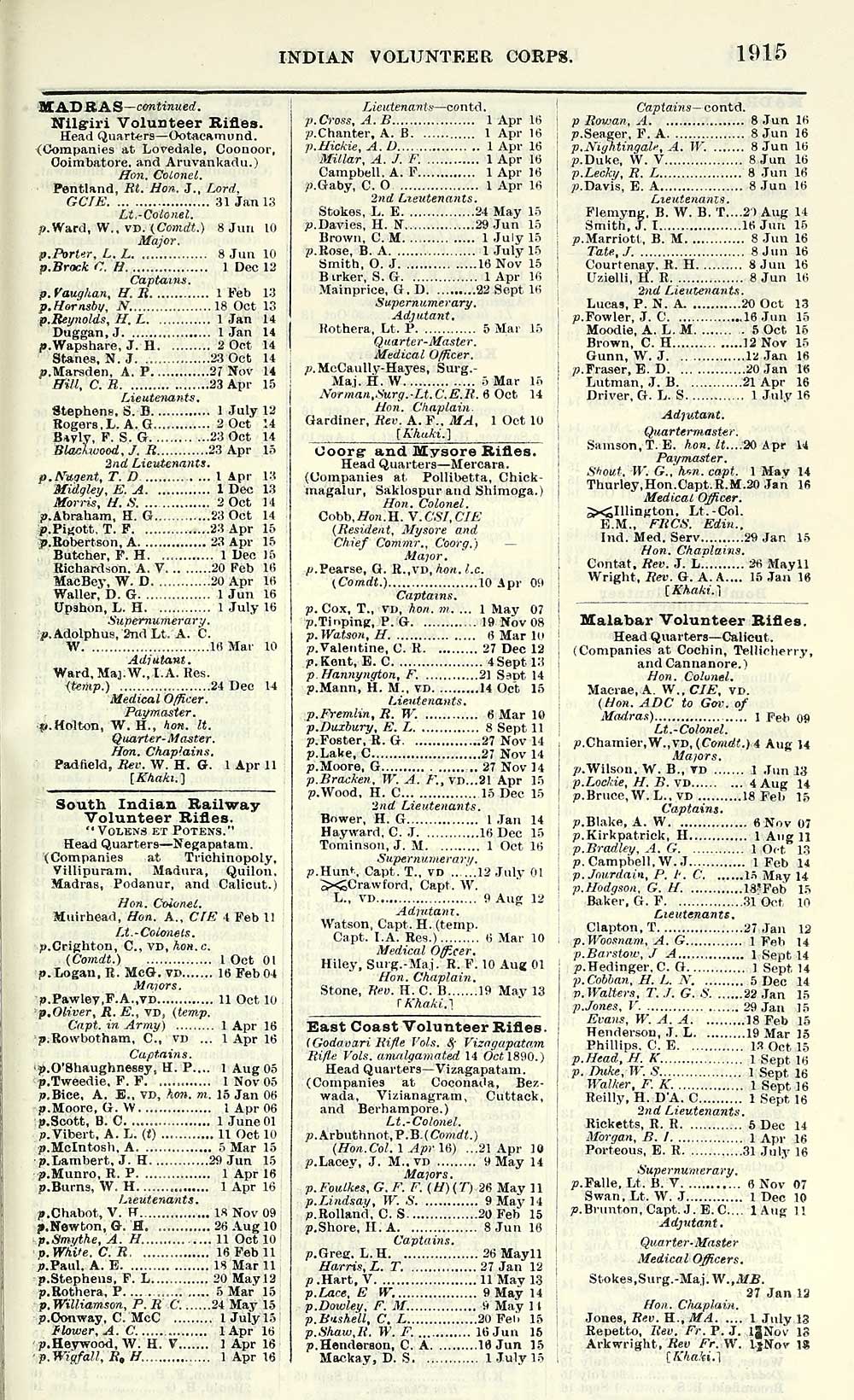
During the First World War, Rev Padfield was the Hon Chaplain of the Nilgiri Rifle Volunteers, headquartered in Ootacamund with companies at Lovedale, Aravankadu, Coonoor, and Coimbatore. The Hon Colonel was Lord Pentland, then the Governor of Madras.
We shall have more about Rev Padfield and his management of the School in the next blog post.